NEW "MagCube" Fidget
The 1971 Cube Behind the MagCube™
Every product we make has a lineage, whether we admit it or not...
Sliders descend from worry stones.
Clickers descend from pens.
The MagCube™ lineage is more specific than either, and it's a better story, so I'm going to tell it properly before the release video makes it look like I invented something original.
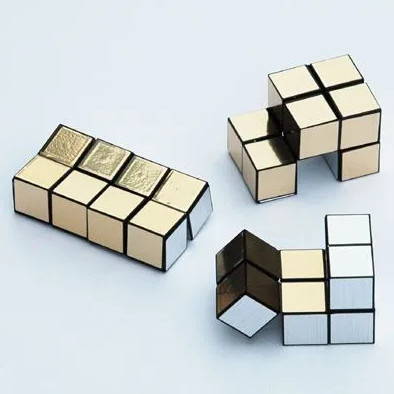
Image courtesy of gyroscope.com
A Man Dividing A Cube In Half
In 1971, a Japanese designer named Naoki Yoshimoto was working on what sounds like the least commercial problem imaginable: how many ways can you split a cube into two equal halves?
Most of us would get to "diagonally" and go back to our day. Yoshimoto kept going, and somewhere in that process he discovered something genuinely strange - a cube built from eight interconnected smaller cubes that could fold through itself, over and over, endlessly.
Turn it inside out and after a few folds you're back at a cube, except the faces that were hidden are now on the outside. Keep going and it cycles forever.
He first showed it in 1972 at a solo exhibition called "From Cube to Space", then produced it commercially as the Yoshimoto Cube.
And here's the detail I love...
It didn't get famous through marketing.
In 1981, a reporter from the Asahi newspaper visited New York and gave one to a curator at the Museum of Modern Art as a souvenir.
The curator was taken with it, and in 1982 the Yoshimoto Cube No. 1 entered MoMA's permanent collection, where it still sits. You can buy a reissue from the MoMA store today.
Fun fact:
Yoshimoto showed his cube three years before Ernő Rubik debuted his.
The original goes further than folding, too. Yoshimoto's cube dissects into two stellated rhombic dodecahedra (yeah, I don't know what that means either :-/) - two star-shaped halves that each somehow contain half the cube's volume.
It's a dissection puzzle wearing a fidget's clothes, decades before "fidget" was a product category.
What Happened To The Idea
The usual thing. The folding-cube mechanism got simplified and copied down the decades.
There were paper versions used as marketing gimmicks. Then, when fidgets became a category, it became the "infinity cube" — eight plastic blocks on metal rivets, a few dollars on Amazon, folding in one fixed loop until the rivets loosen and the whole thing goes sloppy.
I believe there was an aluminium version launched on Kickstarter too.
I believe there was an aluminium version launched on Kickstarter too.
Each generation kept the folding and threw away a little more of what made the original remarkable. The paper ones threw away the permanence. The plastic ones threw away the precision. None of them, as far as I can find, ever went the other direction.
That bothered me more than it probably should have. A design good enough for MoMA's permanent collection deserves at least one descendant made well ...and that's where I come in. :-D
What I Changed
The MagCube™ keeps the soul of the idea — eight cubes, endless folding, an object that reorganizes itself in your hand — and rebuilds the mechanism from scratch.
I'll be honest here...
The big change...
No hinges.
Every folding cube since 1971 has run on hinges, and hinges are both the constraint and the failure point. They force one loop, one path, and they wear.
Instead, each of our eight titanium cubes carries four 5mm spherical neodymium magnets, seated and mechanically retained by screws we machine in-house.
Thirty-two magnets in total.
The spheres are the joints.
I'll be honest here...
The work it took to get to this stage of simplicity is, well, and LOT.
A TON of iterations, tweaks and adjustments to get it working.
The result?
A horribly satisfying, flowing set of cubes that can literally never break - this is a fidget that will outlive you.

